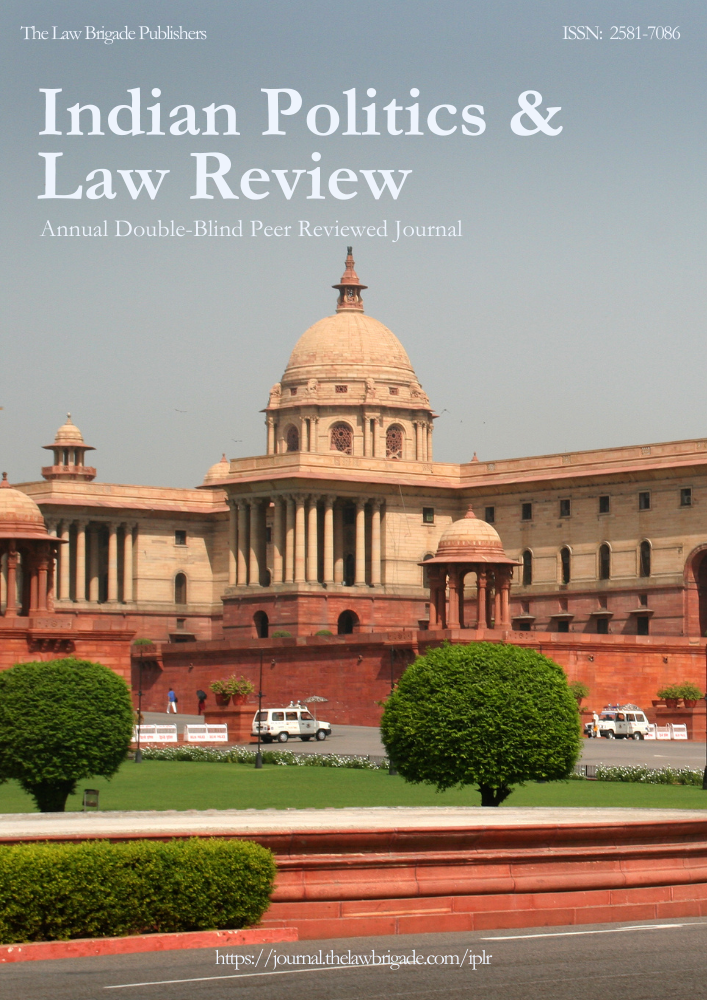
APPLICATION OF UNIFORM CIVIL CODE THROUGH AN INCLUSIVE APPROACH
Downloads
Abstract
Bharatiya Janata Party (BJP) in its manifesto for the 2019 Lok Sabha election mentioned resolve for a Uniform Civil Code (UCC) which has long featured on its agenda The issue is not novel for the BJP or for Indian politics: it has been at the core and spinoffs of political and legislative deliberations for well over one and half century. The BJP was the principal party in India to assurance the application of UCC if it were to be chosen to power. It may be a matter of days before the subject shoot ahead from the sequence of deliberations to real law as now BJP is at the helm of political power. However, is not a new debate? The crusade for the formation of a UCC for the nation is almost 180 years old. The cultural and legal fabric of India represents a unique blend of codified personal laws of Hindus, Muslims, Christians and Parsis. In the absence of a single statute book for all Indians which are acceptable to all religious communities who co-exist in India, many Indians believe that UCC is definitely desirable and would go a long way in consolidating and amalgamating the Indian nationhood. Ofcourse there are varied opinions which are on its timing and the method in which it should be comprehended. The political and academic leaders should try to find out agreement as an alternative of using it as a poignant issue to gain political benefit. The question is not of shielding the minority, or even stimulating national harmony, it is basically one of treating each human person with dignity, something which personal laws have so far futile to do.
External References to this Article
Loading reference data...
Readership Data
Refreshing Cached Analytics Data
The cached analytics data has become stale and journal.thelawbrigade.com is making a fresh request to fetch the latest data from Google Analytics. This may take 20-30 seconds depending on the server response time from Google Analytics. Please do not close the browser during this time. We appreciate your patience.
License Terms
Ownership and Licensing:
Authors of research papers submitted to any journal published by The Law Brigade Publishers retain the copyright of their work while granting the journal specific rights. Authors maintain ownership of the copyright and grant the journal the right of first publication. Simultaneously, authors agree to license their research papers under the Creative Commons Attribution-ShareAlike 4.0 International (CC BY-SA 4.0) License.
License Permissions:
Under the CC BY-SA 4.0 License, others are permitted to share and adapt the work, even for commercial purposes, provided that appropriate attribution is given to the authors, and acknowledgment is made of the initial publication by The Law Brigade Publishers. This license encourages the broad dissemination and reuse of research papers while ensuring that the original work is properly credited.
Additional Distribution Arrangements:
Authors are free to enter into separate, non-exclusive contractual arrangements for distributing the published version of the work (e.g., posting it to institutional repositories or publishing it in books), provided that the original publication by The Law Brigade Publishers is acknowledged.
Online Posting:
Authors are encouraged to share their work online (e.g., in institutional repositories or on personal websites) both prior to submission and after publication. This practice can facilitate productive exchanges and increase the visibility and citation of the work.
Responsibility and Liability:
Authors are responsible for ensuring that their submitted research papers do not infringe on the copyright, privacy, or other rights of third parties. The Law Brigade Publishers disclaims any liability for any copyright infringement or violation of third-party rights within the submitted research papers.
Published
Issue
Section
License

This work is licensed under a Creative Commons Attribution-NonCommercial-ShareAlike 4.0 International License.
Copyright © 2026 by Vanshika Kasturi
The copyright and license terms mentioned on this page take precedence over any other license terms mentioned on the article full text PDF or any other material associated with the article.