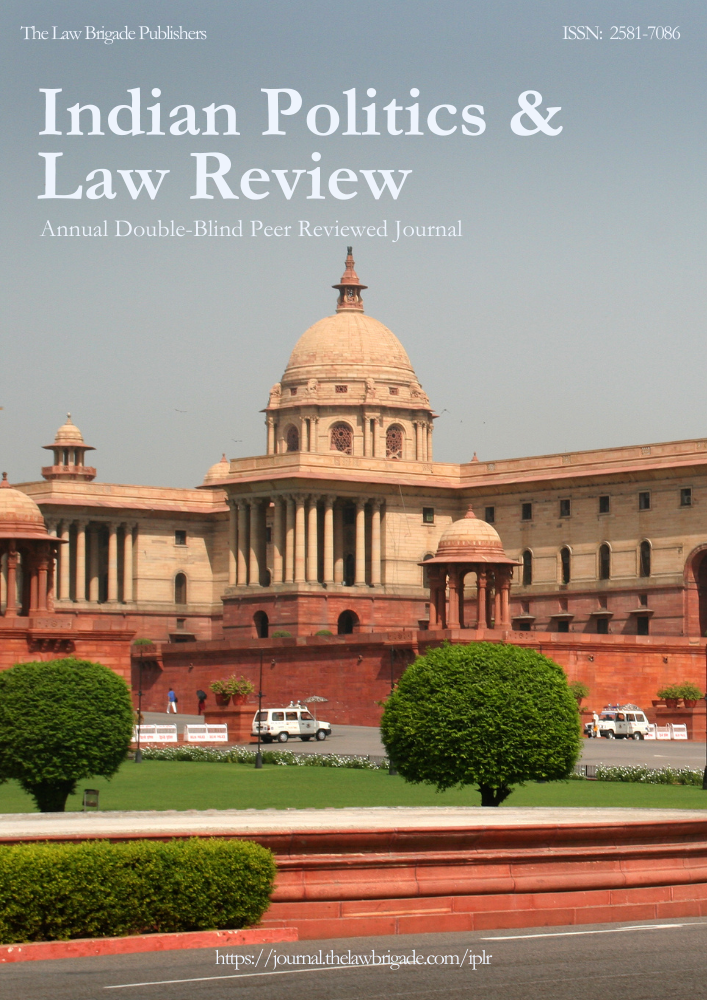
THE ROLE OF GOVERNORS IN MAINTAINING INDIA'S FEDERAL STRUCTURE
Downloads
Abstract
Chapter II (Article 153-163) of the Constitution of India deals with the appointment and powers of the Governors. Even a cursory reading of these constitutional provisions clearly indicates that they can only exercise powers that are granted to them by the Constitution or a law made under it. In Shamsher Singh vs. State of Punjab, 1974, the seven-judge Bench of the Apex Court held that the governor must exercise his powers only upon and in accordance with the aid and advice of the ministers, save in a few well-known exceptional situations. In the Constituent Assembly in June 1949, Dr. B.R. Ambedkar specifically stated that the governor under the Constitution has no functions which he can discharge by himself. No functions at all. At the same time, he has certain duties to perform. However, it has been frequently observed that the unwanted tussle between the governor and the elected government with the chief minister at its head is taking place on various pretexts. This phenomenon is more visible in the Opposition-run States. In the recent past, such acrimonious incidents took place in the States of Punjab, Tamil Nadu, West Bengal, Maharashtra, Kerala etc. because of the governor 's transgressing their Constitutional limits. This has a direct bearing on the Centre-State relations and the federal structure of the country. This paper delves into different aspects of the problem, it's ramifications upon the federal structure of the country, and also tries to suggest the possible solutions.
External References to this Article
Loading reference data...
Readership Data
Refreshing Cached Analytics Data
The cached analytics data has become stale and journal.thelawbrigade.com is making a fresh request to fetch the latest data from Google Analytics. This may take 20-30 seconds depending on the server response time from Google Analytics. Please do not close the browser during this time. We appreciate your patience.
License Terms
Ownership and Licensing:
Authors of research papers submitted to any journal published by The Law Brigade Publishers retain the copyright of their work while granting the journal specific rights. Authors maintain ownership of the copyright and grant the journal the right of first publication. Simultaneously, authors agree to license their research papers under the Creative Commons Attribution-ShareAlike 4.0 International (CC BY-SA 4.0) License.
License Permissions:
Under the CC BY-SA 4.0 License, others are permitted to share and adapt the work, even for commercial purposes, provided that appropriate attribution is given to the authors, and acknowledgment is made of the initial publication by The Law Brigade Publishers. This license encourages the broad dissemination and reuse of research papers while ensuring that the original work is properly credited.
Additional Distribution Arrangements:
Authors are free to enter into separate, non-exclusive contractual arrangements for distributing the published version of the work (e.g., posting it to institutional repositories or publishing it in books), provided that the original publication by The Law Brigade Publishers is acknowledged.
Online Posting:
Authors are encouraged to share their work online (e.g., in institutional repositories or on personal websites) both prior to submission and after publication. This practice can facilitate productive exchanges and increase the visibility and citation of the work.
Responsibility and Liability:
Authors are responsible for ensuring that their submitted research papers do not infringe on the copyright, privacy, or other rights of third parties. The Law Brigade Publishers disclaims any liability for any copyright infringement or violation of third-party rights within the submitted research papers.
Published
Issue
Section
License

This work is licensed under a Creative Commons Attribution-NonCommercial-ShareAlike 4.0 International License.
Copyright © 2026 by Dr. Rakesh Chandra
The copyright and license terms mentioned on this page take precedence over any other license terms mentioned on the article full text PDF or any other material associated with the article.