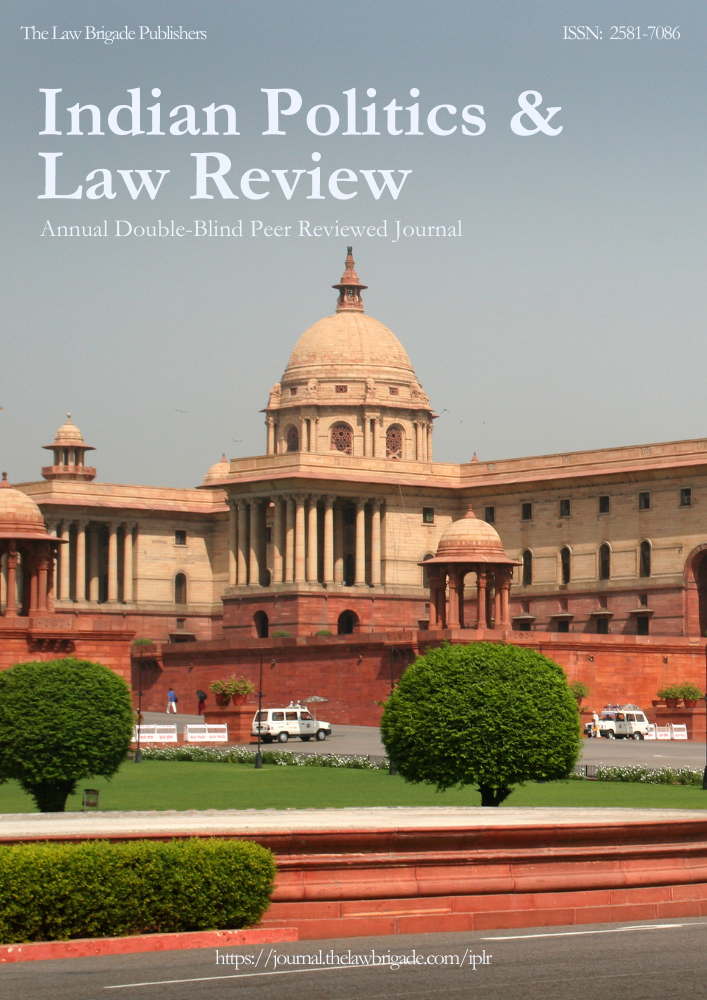
Parachute Politics and the Erosion of Federalism: Restoring State Representation in the Rajya Sabha
Downloads
DOI:
https://doi.org/10.55662/IPLR.2026.1101Keywords:
Representation of People Act, 1951, Parliament, Rajya Sabha, Sarkaria Commission reportAbstract
The Rajya Sabha was envisioned as federal safeguard to ensure State representation at the national level. The 2003 amendment to the Representation of People Act, 1951 removed the domicile requirement for candidates and allowed for individuals with no territorial nexus to be elected. This was challenged and upheld in the case of Kuldip Nayar v. Union of India, wherein the amendment was criticized for diluting the federal character of Rajya Sabha. Commissions like Punchhi and NCRWC have recommended the reinstatement of the territorial link to preserve the institutions’ purpose. The rise in parachute candidates has also led to the chamber being used for political convenience, weakening its role as a voice for States. These practices undermine Constitutional morality and cooperative federalism. Reforms both legal and cultural are necessary to restore the Rajya Sabha’s role as a representative of States’ interests in India’s quasi-federal framework. The judiciary has affirmed through cases such as S.R. Bommai v. Union of India that federalism forms part of the basic structure of the Constitution, yet representational practices in the Rajya Sabha continue to erode the above in substance. Political parties have increasingly treated Rajya Sabha’s role as representative of States’ interests in India’s quasi- federal framework, including the reinstatement of domicile linked eligibility criterion and greater transparency in the candidate’s nomination process.
External References to this Article
Loading reference data...
Readership Data
Refreshing Cached Analytics Data
The cached analytics data has become stale and journal.thelawbrigade.com is making a fresh request to fetch the latest data from Google Analytics. This may take 20-30 seconds depending on the server response time from Google Analytics. Please do not close the browser during this time. We appreciate your patience.
References
Representation of People Act 1951, s3.
The Constitution of India 1950, art 79.
Sarkaria commission report, chapter II Legislative relations (1988), < Report of the Sarkaria Commission ISCS> accessed 4 May 2025.
The Constitution of India 1950, art 80.
The Constitution of India 1950, art 84.
Representation of People Act 1951, s3.
Representation of People Act 1951, s3.
Commission on centre-state relations report, volume II (2010), accessed 4 May 2025.
Kuldip Nayar v. Union of India (2006) 7 SCC 1.
Commission on centre-state relations report, volume II (2010), accessed 4 May 2025.
Commission on centre-state relations report, volume II (2010), accessed 4 May 2025.
Commission on centre-state relations report, volume II (2010), accessed 4 May 2025.
MP Jain, ‘Chapter 1’, Indian Constitutional Law, vol 1 (9th edn).
Austin Granville, The Indian Constitution: Cornerstone of a Nation (Oxford University Press).
The Constitution of India 1950, art 80.
‘Cong Leader Complains about Party’s RS List, Says Local Leaders Feel Dejected by Parachute Candidates’ (The Print) <https://theprint.in/politics/cong-leader-complains-about-partys-rs-list-says-local-leaders-feel-dejected-by-parachute-candidates/978219> accessed 4 May 2025.
S. R. Bommai v Union of India 1994 AIR SC 1918.
R. C. Poudyal v Union of India 1993 AIR SC 1804.
The National Commission to Review the Working of the Constitution, volume I, Chapter 5< chapter 5.pdf > accessed 4 May 2025.
Commission on centre-state relations report, volume II (2010), accessed 4 May 2025.
Navtej Singh Johar v. Union of India (2018) 10 SCC.
Commission on centre-state relations report, volume II (2010), accessed 4 May 2025.
Commission on centre-state relations report, volume II (2010), accessed 4 May 2025.
License Terms
Ownership and Licensing:
Authors of research papers submitted to any journal published by The Law Brigade Publishers retain the copyright of their work while granting the journal specific rights. Authors maintain ownership of the copyright and grant the journal the right of first publication. Simultaneously, authors agree to license their research papers under the Creative Commons Attribution-ShareAlike 4.0 International (CC BY-SA 4.0) License.
License Permissions:
Under the CC BY-SA 4.0 License, others are permitted to share and adapt the work, even for commercial purposes, provided that appropriate attribution is given to the authors, and acknowledgment is made of the initial publication by The Law Brigade Publishers. This license encourages the broad dissemination and reuse of research papers while ensuring that the original work is properly credited.
Additional Distribution Arrangements:
Authors are free to enter into separate, non-exclusive contractual arrangements for distributing the published version of the work (e.g., posting it to institutional repositories or publishing it in books), provided that the original publication by The Law Brigade Publishers is acknowledged.
Online Posting:
Authors are encouraged to share their work online (e.g., in institutional repositories or on personal websites) both prior to submission and after publication. This practice can facilitate productive exchanges and increase the visibility and citation of the work.
Responsibility and Liability:
Authors are responsible for ensuring that their submitted research papers do not infringe on the copyright, privacy, or other rights of third parties. The Law Brigade Publishers disclaims any liability for any copyright infringement or violation of third-party rights within the submitted research papers.
Citation Metrics
Published
Issue
Section
License
Copyright (c) 2026 Rhea Chaudhary (Author)

This work is licensed under a Creative Commons Attribution-NonCommercial-ShareAlike 4.0 International License.
Copyright © 2026 by Rhea Chaudhary
The copyright and license terms mentioned on this page take precedence over any other license terms mentioned on the article full text PDF or any other material associated with the article.
How to Cite
Citations List